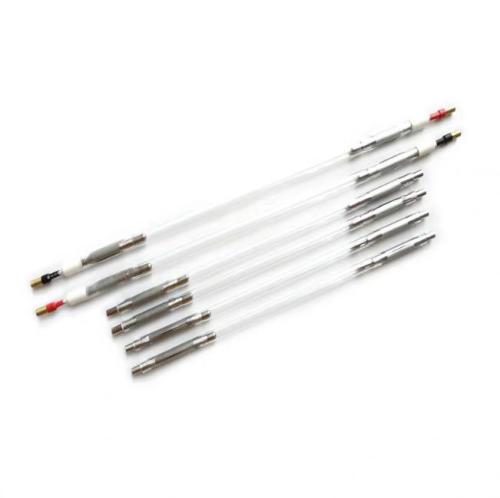
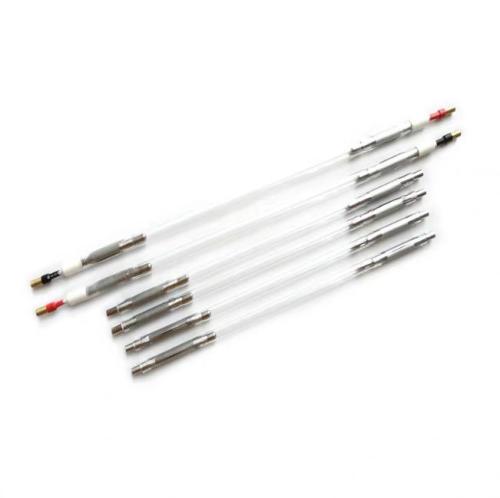
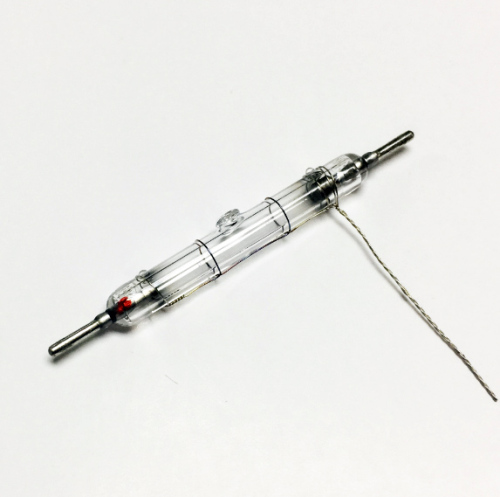
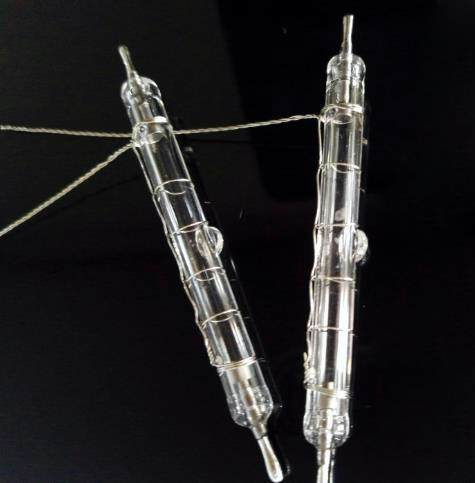
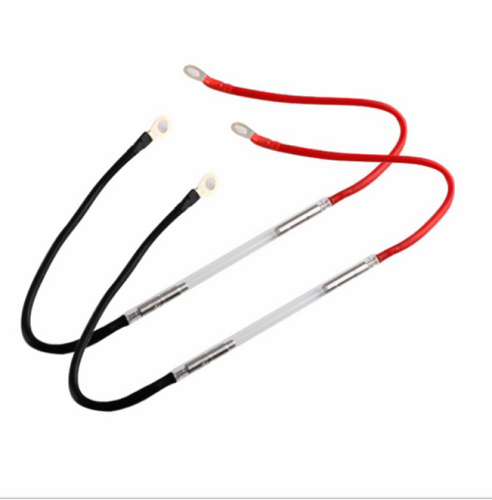
Pulse Mercury Free Ultraviolet Sterilization Lamp
The light produced by the pulsed xenon lamp has the following characteristics:
(1) High penetration
The pulsed xenon lamp device can operate in a short time (10 ~ 100 μ s) High peak power can be generated by converting the electric energy stored in the energy storage capacitor into light energy. Pulsed strong light can destroy bacteria such as cell wall and DNA, and can kill bacteria in many ways. Compared with common ultraviolet lamps, ultraviolet lamps kill bacteria through continuous spectrum. Under the same power, pulsed xenon lamps have stronger peak power, which is unmatched by ultraviolet lamps. Because the penetration of ultraviolet light is very weak and can not penetrate product packaging, the high penetration of pulse xenon lamp device is used for sterilization in food packaging, water treatment and other processes.
Shenzhen Lanpu Rick Technology Co., Ltd
(2) Low temperature
Pulsed strong light has a certain photothermal effect in the process of sterilization, but it is not the main action mode. According to the analysis of the following aspects:
A pulsed intense light releases energy in the form of pulses, and the process of releasing energy is relatively short. This process is completed in microsecond level, so the generated heat cannot be accumulated, resulting in temperature rise;
B. the pulsed xenon lamp has enough time to cool relative to its energy release time in a working cycle;
C. pulsed xenon lamp uses high-voltage trigger pulse to ionize the gas in the lamp tube, and preheating is not required before starting work;
D pulse xenon lamp relies on instantaneous peak energy for sterilization, so the average value of its output energy is small.
(3) Immediate control
The pulse xenon lamp device has a control module, which can enable the pulse xenon lamp to start and stop at any time and respond quickly. The ultraviolet lamp needs to be preheated before starting, which can not meet the requirements of on-demand. In some special occasions, such as the packaging process of protein drugs, due to the denaturation of protein by ultraviolet light, accurate control is required during the disinfection of these products, Disinfect the parts to be disinfected immediately when entering, and stop the parts that cannot receive ultraviolet radiation immediately after entering. Therefore, it is more suitable to apply pulsed strong light device in these occasions.
(4) High energy efficiency
The energy released by pulsed xenon lamp is in the form of optical pulse. Under the same input power, compared with the UV lamp with continuous output energy, the peak energy of pulsed xenon lamp in a short time is unmatched by ordinary UV lamp.
(5) High adaptability
Pulse xenon lamp device has good adaptability to different requirements in practical application:
A different overall dimensions can be selected according to the actual use occasion and the actual space. The existing production technology can process the pulse xenon lamp into tubular, spiral, "U" shape and other shapes;
B the volume of pulse xenon lamp is very small and can be flexibly arranged according to the actual use space. Compared with the volume of UV lamp, the layout of pulse xenon lamp is more flexible;
C different parameters can be set within a reasonable range according to the actual use occasion to change the input energy of xenon lamp, so as to change the output energy to adapt to the change of use requirements. It is more applicable to the same set of devices.
(6) Safe
At present, the commonly used ultraviolet sterilization lamp is a low-pressure mercury lamp, the pulse xenon lamp device is a xenon lamp, and the filling gas in the lamp tube is inert gas xenon. There is no problem of mercury leakage, and the safety factor is higher. At the same time, due to the instant start and stop characteristics of xenon lamp, there will be no risk of ultraviolet leakage. Pulse xenon lamp tube material can filter vacuum ultraviolet rays and will not produce ozone [55], while ultraviolet sterilization lamp may produce ozone, which is in danger of exceeding the standard of ozone.
2.3 sterilization mechanism of pulsed xenon lamp
Pulsed intense light itself is characterized by high light radiation intensity. It can be seen from Fig. 2-2 that the spectrum emitted by pulsed xenon lamp is wide, covering the spectrum of 200 ~ 1100nm; At the same time, there are high peaks in the UV band of 200 ~ 275 nm (UV-C) and 275 ~ 320 nm (UV-B). In addition, there are peaks second only to the UV part in the visible part (400 ~ 760 nm) and the infrared part (760 ~ 1000 nm). Therefore, the sterilization mechanism of pulsed strong light is different from that of ultraviolet light. Pulsed strong light not only plays a photochemical role in the sterilization process
Leading role, as well as photothermal effect. There are four ways to kill microorganisms by pulsed strong light: (1) destroy microbial cell membrane; (2) Decomposition of enzymes in microorganisms; (3) Destroy the nucleic acid of genetic material in microbial cells; (4) Photothermal action leads to evaporation and expansion of water in microbial cells, resulting in cell rupture.
Studies have shown that [56], after pulsed strong light treatment of yeast cells, vacuoles expand, cell membrane deform and a large number of free proteins appear in the cells. After continuous UV treatment, the shape of yeast cells was not much different from that before treatment. This shows that in the process of pulsed strong light treatment, in addition to the damage to genetic material similar to ultraviolet, due to its strong penetration, the photochemical action of UV-B and UV-C leads to the decomposition of enzymes in microbial cells, resulting in a large number of free proteins. At the same time, it also decomposes microbial cell membrane proteins, resulting in cell membrane damage and deformation. The expansion of vacuoles in cells indicates that pulsed strong light is on micro cells
There is photothermal effect in the process of biological treatment. Due to short-time high-energy pulsed light radiation, the water in vacuoles in cells evaporates and expands until cells rupture.